Challenging Restitution Orders After Supreme Court Decision
ellingburg restitution is-criminal penalty supreme court

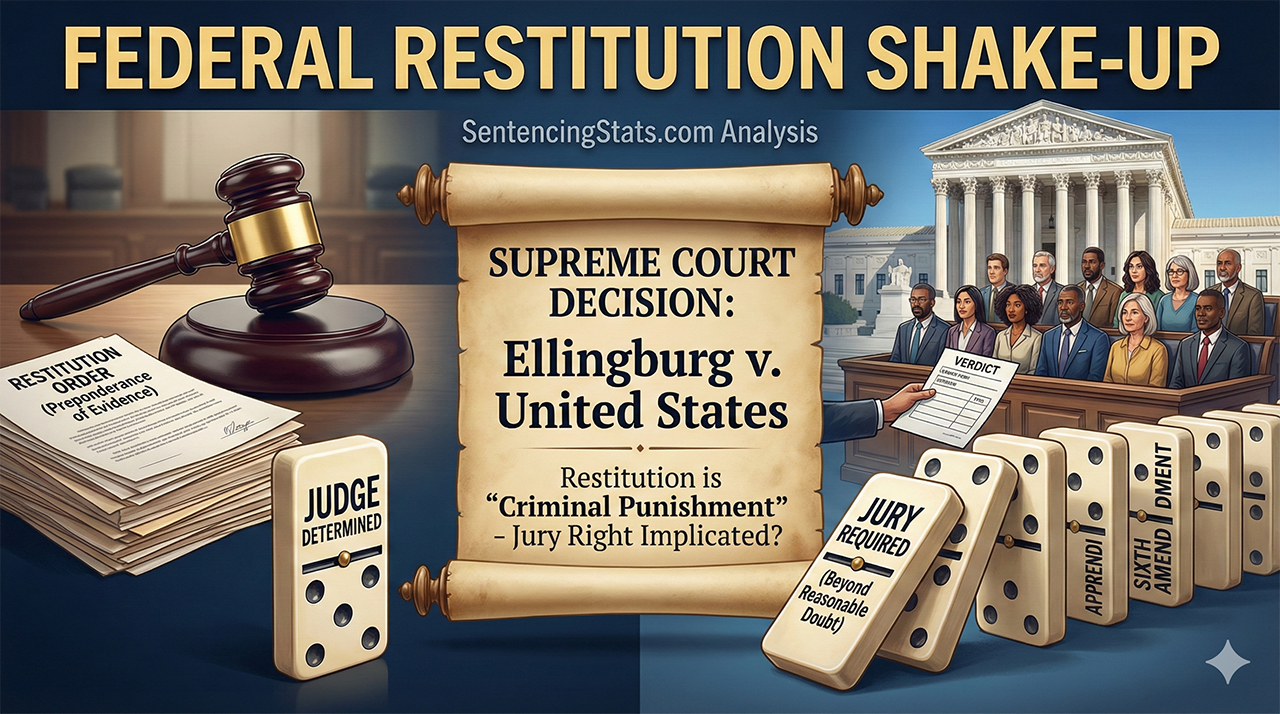
In a unanimous decision on January 20, 2026, the Supreme Court fundamentally altered the landscape of federal sentencing. By ruling in Ellingburg v. U.S. that restitution is “plainly criminal punishment,” the Court has opened the door to significant due process challenges. In this article, originally published in Law360, we explore why the “Wild West” of restitution is over and how defense counsel can use this ruling to demand jury findings and stricter evidentiary standards.

Read More


Ellingburg Supreme Court Decision Infographic: The New Ellingburg Rule Explained

g

The Supreme Court’s recent ruling in Ellingburg v. U.S. has complex implications for every federal criminal case involving financial loss. To help you visualize this seismic shift, we’ve created a new infographic: “The New Ellingburg Rule Explained.” This visual guide maps out the transition of restitution from a civil remedy to a criminal penalty, highlighting the new “Apprendi dominoes” that defense counsel can leverage to demand jury findings and higher standards of proof.

Read More


Examining Sentencing Disparities in January 6th Cases: Insights from SentencingStats.com’s Latest Analysis

SentencingStats.com recently completed a comprehensive analysis of the sentencing outcomes for defendants involved in the January 6th incident at the U.S. Capitol. This study examines 934 defendants who were convicted and sentenced through August 12, 2024. The findings shed light on significant sentencing disparities arising from the exercise of judicial and prosecutorial discretion, highlighting critical gaps in the current legal framework.

Read More


Post-Chevron: The End of Sentencing Guidelines: A New Era for Justice

In their thought-provoking guest article in Law 360, “Post-Chevron, Good Riddance to the Sentencing Guidelines,” co-authors Mark Allenbaugh, Doug Passon, and Alan Ellis dive deep into the implications of the Supreme Court’s recent decision in Loper Bright Enterprises v. Raimondo. This landmark case has effectively dismantled the long-standing Chevron doctrine, which traditionally granted deference to agency interpretations of ambiguous statutes.

Read More


Does Pulsifer pulverize sentencing reform?

The Supreme Court made a decision in Pulsifer v. United States that significantly narrowed the reach of the “safety valve” provision, which allows for reduced sentences in federal drug offenses, undermining recent efforts by Congress to mitigate the harshness of mandatory minimum sentences. The majority’s interpretation, as described by Justice Elena Kagan, restricts the eligibility

Read More