Challenging Restitution Orders After Supreme Court Decision

ellingburg restitution is-criminal penalty supreme court

In a unanimous decision on January 20, 2026, the Supreme Court fundamentally altered the landscape of federal sentencing. By ruling in Ellingburg v. U.S. that restitution is “plainly criminal punishment,” the Court has opened the door to significant due process challenges. In this article, originally published in Law360, we explore why the “Wild West” of restitution is over and how defense counsel can use this ruling to demand jury findings and stricter evidentiary standards.

Read More

Ellingburg Supreme Court Decision Infographic: The New Ellingburg Rule Explained

g

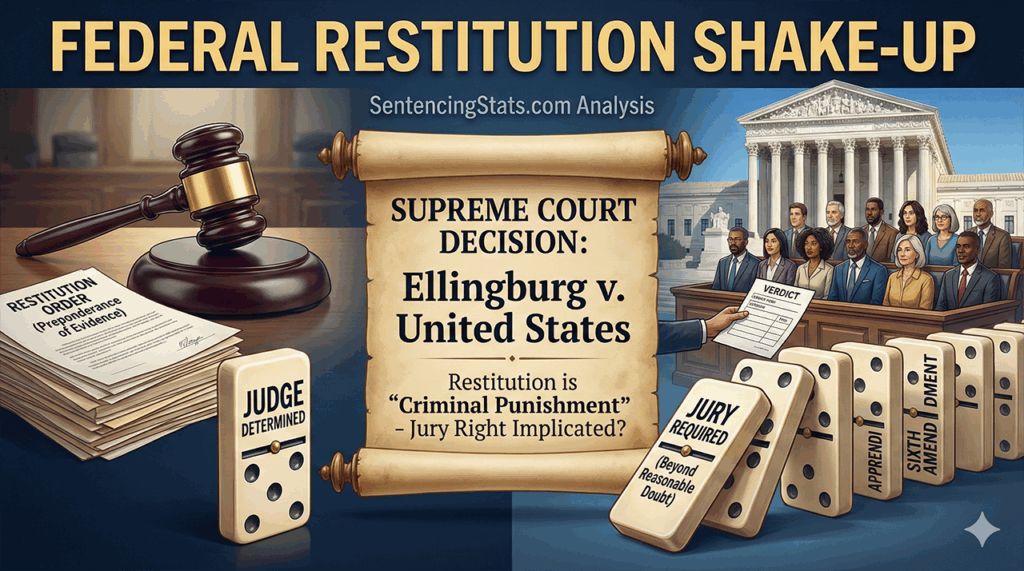
The Supreme Court’s recent ruling in Ellingburg v. U.S. has complex implications for every federal criminal case involving financial loss. To help you visualize this seismic shift, we’ve created a new infographic: “The New Ellingburg Rule Explained.” This visual guide maps out the transition of restitution from a civil remedy to a criminal penalty, highlighting the new “Apprendi dominoes” that defense counsel can leverage to demand jury findings and higher standards of proof.

Read More

Supreme Court’s Ellingburg Ruling Upends Federal Restitution

In a unanimous ruling, the Supreme Court’s Ellingburg decision has reclassified restitution as “plainly criminal punishment,” ending its treatment as a civil remedy. Our latest Law360 article explores how defense counsel can now demand Sixth Amendment protections—including jury findings and stricter evidentiary standards—to challenge restitution orders in federal sentencing.

Read More

Law360: Ex-Chicago Politician’s Case May Further Curb Fraud Theories

future of federal fraud

Will Thompson v. United States Redefine Fraud Laws?

The Supreme Court’s Thompson v. United States could redefine federal fraud law, specifically limiting charges to explicit falsehoods. Currently, misleading statements—even half-truths—are often treated as fraud, but Thompson challenges this interpretation, highlighting a split between circuits. If the Court narrows the definition, fraud prosecutions may only target direct lies, impacting both charges and plea deals.

Read More

Post-Chevron: The End of Sentencing Guidelines: A New Era for Justice

In their thought-provoking guest article in Law 360, “Post-Chevron, Good Riddance to the Sentencing Guidelines,” co-authors Mark Allenbaugh, Doug Passon, and Alan Ellis dive deep into the implications of the Supreme Court’s recent decision in Loper Bright Enterprises v. Raimondo. This landmark case has effectively dismantled the long-standing Chevron doctrine, which traditionally granted deference to agency interpretations of ambiguous statutes.

Read More

Sentencing Reform Advocates Hail Landmark Acquitted Conduct Amendment to U.S. Sentencing Guidelines

Washington, D.C. – In a major victory for sentencing reform advocates, the U.S. Sentencing Commission has amended the U.S. Sentencing Guidelines to preclude the consideration of acquitted conduct at sentencing. This amendment, which goes into effect on August 1, 2024, marks a significant step towards a more constitutional and equitable sentencing system.

Read More

Does Pulsifer pulverize sentencing reform?

The Supreme Court made a decision in Pulsifer v. United States that significantly narrowed the reach of the “safety valve” provision, which allows for reduced sentences in federal drug offenses, undermining recent efforts by Congress to mitigate the harshness of mandatory minimum sentences. The majority’s interpretation, as described by Justice Elena Kagan, restricts the eligibility

Read More