Challenging Restitution Orders After Supreme Court Decision

ellingburg restitution is-criminal penalty supreme court

In a unanimous decision on January 20, 2026, the Supreme Court fundamentally altered the landscape of federal sentencing. By ruling in Ellingburg v. U.S. that restitution is “plainly criminal punishment,” the Court has opened the door to significant due process challenges. In this article, originally published in Law360, we explore why the “Wild West” of restitution is over and how defense counsel can use this ruling to demand jury findings and stricter evidentiary standards.

Read More

Ellingburg Supreme Court Decision Infographic: The New Ellingburg Rule Explained

g

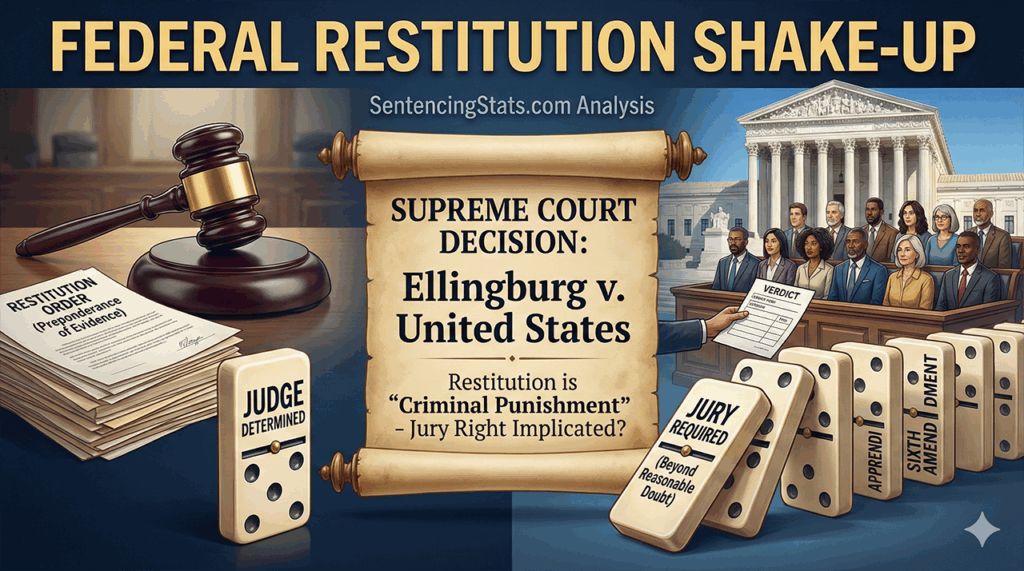
The Supreme Court’s recent ruling in Ellingburg v. U.S. has complex implications for every federal criminal case involving financial loss. To help you visualize this seismic shift, we’ve created a new infographic: “The New Ellingburg Rule Explained.” This visual guide maps out the transition of restitution from a civil remedy to a criminal penalty, highlighting the new “Apprendi dominoes” that defense counsel can leverage to demand jury findings and higher standards of proof.

Read More

Supreme Court’s Ellingburg Ruling Upends Federal Restitution

In a unanimous ruling, the Supreme Court’s Ellingburg decision has reclassified restitution as “plainly criminal punishment,” ending its treatment as a civil remedy. Our latest Law360 article explores how defense counsel can now demand Sixth Amendment protections—including jury findings and stricter evidentiary standards—to challenge restitution orders in federal sentencing.

Read More

Fifth Circuit Remands in Restitution Matter

On October 19, 2017, in a per curiam decision, the Fifth Circuit reversed a restitution award where the purported victim had received the services contracted for.  In so holding, the Fifth Circuit noted that restitution was not punitive in nature.  This is in conflict with some circuits that hold restitution is punitive in nature. The

Read More