
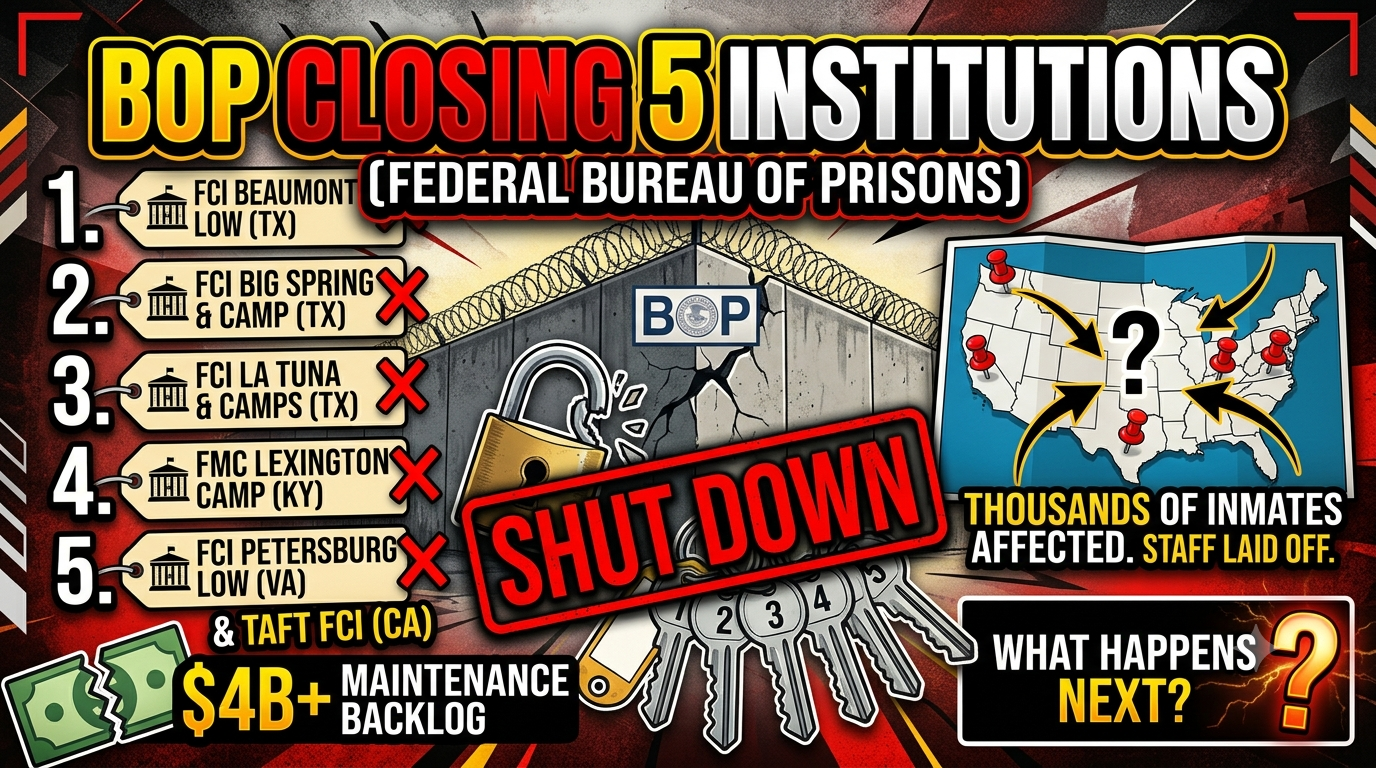
BOP Closing of 5 Institutions will have Massive Implications Across the Country

On July 1, 2026, the U.S. Bureau of Prisons—the nation’s largest prison system—announced that it will be closing five of its currently-operating institutions in order “to address decades of deferred maintenance and extreme staffing challenges.”  (It also announced that it was closing Taft FCI, which already has been shuttered since 2020). As this round of closures follows other recent ones, it seems that the Bureau of Prisons answer to problematic institutions and chronic staffing shortages is not to fix them, but simply to close them, which will only exacerbate the same problems at the remaining institutions.
 
Indeed, the Bureau of Prisons currently is operating at 5.8% over its combined rated capacity for all institutions.  SentencingStats.com, Inc., estimates that these closures will increase that metric to 9.4%.  Currently, over half of the Bureau’s institutions are operating over their respective rated capacities with over a dozen operating at over 50% of their rated capacities.  With no new prisons under construction, this down-sizing will necessarily magnify the overpopulation problem and concomitant staffing shortages rendering already dangerous institutions even more unsafe for staff and inmates.
 
Congress, of course, can rectify this issue with proper funding. In the meantime, it is incumbent on U.S. District Court judges and the U.S. Sentencing Commission to take immediate steps to alleviate the reality of prison overcrowding by imposing shorter sentences or, ideally, alternatives to incarceration. In that regard, it is far past time for the U.S. Sentencing Commission to finally take seriously the directive Congress gave it over 40 years ago in the Sentencing Reform Act of 1984, to wit, “[t]he Commission, in promulgating guidelines pursuant . . . shall take into account the nature and capacity of the penal, correctional, and other facilities and services available. . . . The sentencing guidelines prescribed under this chapter shall be formulated to minimize the likelihood that the Federal prison population will exceed the capacity of the Federal prisons, as determined by the Commission.”  28 U.S.C. § 944(g).  

The information provided in this website does not, and is not intended to, constitute legal advice; instead, all information, content, and materials available on this site are for general informational purposes only. Information in this email and corresponding website may not constitute the most up-to-date legal or other information. 

Readers of this website should contact their attorney to obtain advice with respect to any particular legal matter. No reader, user, or recipient should act or refrain from acting on the basis of information on this site without first seeking legal advice from counsel in the relevant jurisdiction. Only your individual attorney can provide assurances that the information contained herein – and your interpretation of it – is applicable or appropriate to your particular situation.

All liability with respect to actions taken or not taken based on the contents of this website are hereby expressly disclaimed. The content is provided “as is;” no representations are made that the content is error-free.

SentencingStats.com, Inc. is not a law firm and is a private analytics company and not affiliated with the U.S. Government. Verification by our team only means the defendant will likely qualify for an Amendment 821 reduction, based on the information provided. There is never a way to predict what a judge decides in an individual case and no guarantee if we verify a defendant that a judge may reduce their sentence. 

[pmpro_signup submit_button="Register Now!" short="emailonly" level="7" login="0" redirect="referrer"]