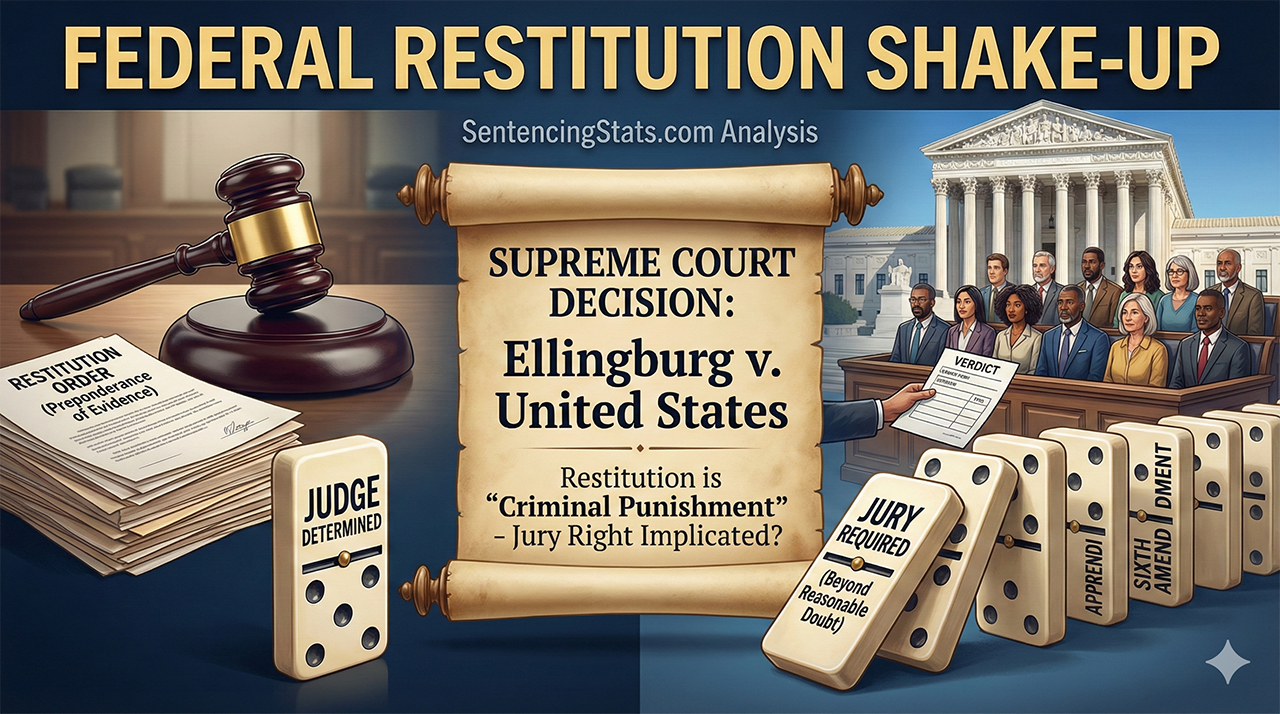
At SentencingStats.com, Inc., included in our sentencing data, which covers over 20 years of federal sentencings nationwide, is data on restitution amounts. Restitution awards are a significant component of the federal criminal justice system with some estimates indicating the Department of Justice is collecting around $1 billion in restitution each year with billions more remaining outstanding.
Despite its importance, restitution traditionally has not been charged in the indictment and generally left to courts to determine by a preponderance of the evidence at sentencing. A restitution award can saddle a defendant with years of debt even after completion of any term of imprisonment or supervised release, and can negatively impact a defendant’s creditworthiness making reintegration even more difficult. Unlike fines, a court may not waive restitution for a defendant’s inability to pay it.
All that might change.
Earlier today, the Supreme Court issued its decision in Ellingburg v. United States, holding that “Restitution under the MVRA is plainly criminal punishment for purposes of the Ex Post Facto Clause.” Ellingburg may have significant and immediate implications for federal defendants facing orders of restitution at sentencing and certainly those currently negotiating possible plea agreements.
Because the Government agreed with the petitioner that restitution is a criminal penalty, the Supreme Court appointed amicus to argue that it was not. Amicus argued in its brief that if restitution is a criminal penalty, then the Sixth Amendment applies to it such that, per Apprendi, the amount of restitution is an element of the offense and therefore would have to be charged in the indictment and either admitted by the defendant or found by a jury. According to amicus in Ellingburg,
the “Sixth Amendment reserves to juries the determination of any fact, other than the fact of a prior conviction, that increases a criminal defendant’s maximum potential sentence.” S. Union Co. v. United States, 567 U.S. 343, 346 (2012). The Court has applied that rule “to criminal fines,” and thus juries must “find beyond a reasonable doubt facts that determine [a] fine’s maximum amount.” Id. at 346, 350. If MVRA restitution were also deemed criminal punishment, the same rule would presumably apply. And because the MVRA requires judges to find by a preponderance of the evidence facts that increase the maximum amount of restitution, 18 U.S.C. § 3664(e), MVRA restitution would violate the Sixth Amendment were it criminal punishment—a serious problem with the government’s position in this case that it brushes off in a footnote (Br. 26 & 27 n.3). See Hester v. United States, 586 U.S. 1104, 1105-07 (2019) (Gorsuch, J., dissenting from the denial of certiorari).
Brief of Amicus Curiae ISO Judgment Below, Ellingburg v. United States, No. 24-482, Aug. 22, 2025, at 30-31 (emphasis added).[1]
Indeed, as Justice Thomas observed in his concurrence in Apprendi, “[c]ases from the founding to roughly the end of the Civil War establish . . . the common-law understanding that a fact that is by law the basis for imposing or increasing punishment is an element [of an offense].” Apprendi, 530 U.S. at 501-502 (Thomas, J., concurring). Accordingly, “[v]alue was an element because punishment varied with value.” Id. at 503 (emphasis added).
As Justice Gorsuch more recently explained,
as long ago as the time of Henry VIII, an English statute entitling victims to the restitution of stolen goods allowed courts to order the return only of those goods mentioned in the indictment and found stolen by a jury. In America, too, courts held that in prosecutions for larceny, the jury usually had to find the value of the stolen property before restitution to the victim could be ordered. And it’s hard to see why the right to a jury trial should mean less to the people today than it did to those at the time of the Sixth and Seventh Amendments’ adoption.
Hester v. United States, 586 U.S. 1104, 1107 (2019) (Gorsuch, J., joined by Sotomayor, J., dissenting from denial of certiorari) (emphasis added; citations omitted).
Thus, “[o]nce we recognize restitution as being a ‘criminal penalty’ the proverbial Apprendi dominoes begin to fall. . . . [I]t dictates a conclusion that the district court’s order imposing a restitution amount violates the Sixth Amendment’s jury guarantee because . . . [the] amount was based upon facts not admitted to by [Smith] or found by a jury beyond a reasonable doubt.” United States v. Carruth, 418 F.3d 900, 906 (8th Cir. 2005) (Bye, J., dissenting).
Thus, in light of Ellingburg, the current manner in which restitution is imposed may be unconstitutional. We therefore encourage criminal defense attorneys to carefully review Ellingburg and those facing federal charges to discuss its impact on their cases with qualified counsel as soon as possible.
For a visual breakdown of the new Ellingburg rule, check out our Ellingburg infographic here.
Share and Download
We created this infographic to help people understand the new restitution process. Feel free to send a link to this page, post on social or download a free pdf copy of this graphic to share with anyone who may benefit.